
Balanced Bodywork Equine Therapy- an holistic approach to bodywork
Working with the horses nervous system allows us to help them to create new Neuromuscular connections in the body by releasing deep tension patterns and restrictions that no longer serve them and creating healthy, functional movement, balance and stability, and with this a balanced regulated nervous system.
The link to what we see and feel on the outside of the horse impacts their internal state.
When we start to see how tension patterns in our horses bodies are mirrored in their nervous system, it gives us a deeper understanding of why our horses behave certain ways and what we can do to not only help them to be comfortable and confident in their bodies but also more settled settled in their minds.
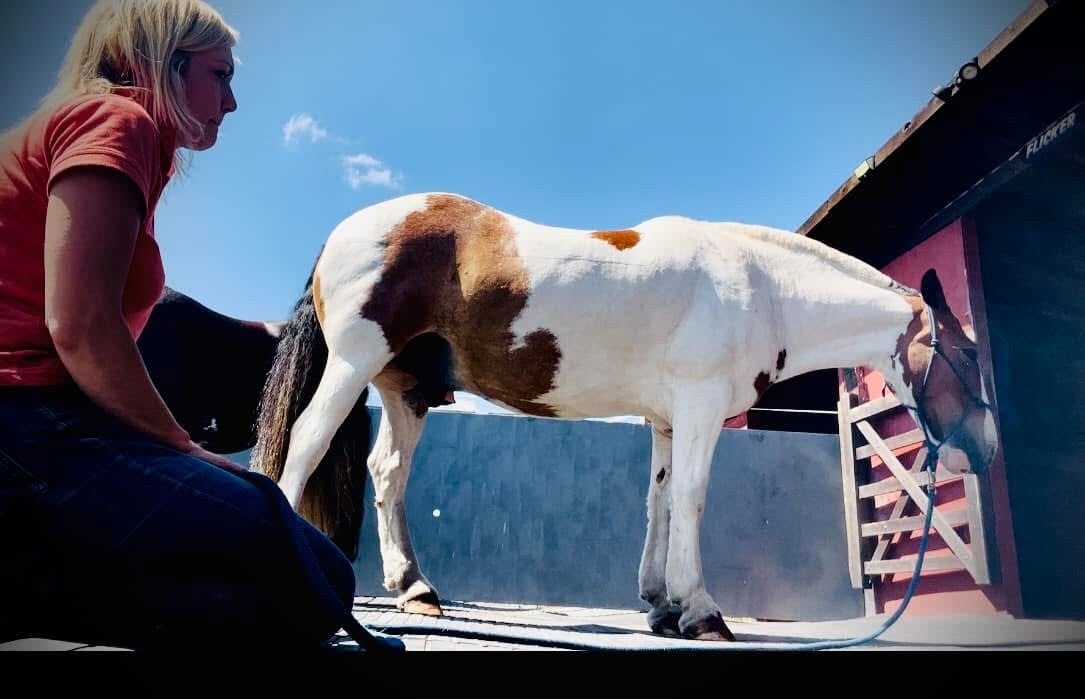
The horse below is a great example of how the tension in the body effects the nervous system, and how we can help the horse emotionally by recognising these patterns and helping the horse to release these and become more balanced.

When I first met this beautiful mare she was very reactive, unsettled, unable to stand still, she was calling her to filed companion, she was disconnected to her owner, she was very tense, this was the best picture I manage to get as she could not stand still. She was operating from a very sympathetic state, this is the part of the nervous system responsible for fight or flight, for survival. Her owner reached out to me as she was concerned how she was tripping, especially with a saddle on and a few days prior to my visit she had collapsed onto the floor while her owner was tightening her girth.
If we look at her body, we can see how her neck is very tight, particularly her ventral (underside) we can see the muscle definitions over her shoulders, she is leaning slightly forwards over her front le, not fully weighting into her heels and extending her knees, her withers are prominent, the angle of her back is quite steep, her hind limbs are close together. Also what cant really be shown in a picture is that her carpal joints (knees) wobbled, they did not fully lock into extension to stabilise her limbs. This is quite a typical posture for a horse who is in a sympathetic state.
Therefore what I could see on the outside was very much mirroring her internal state.
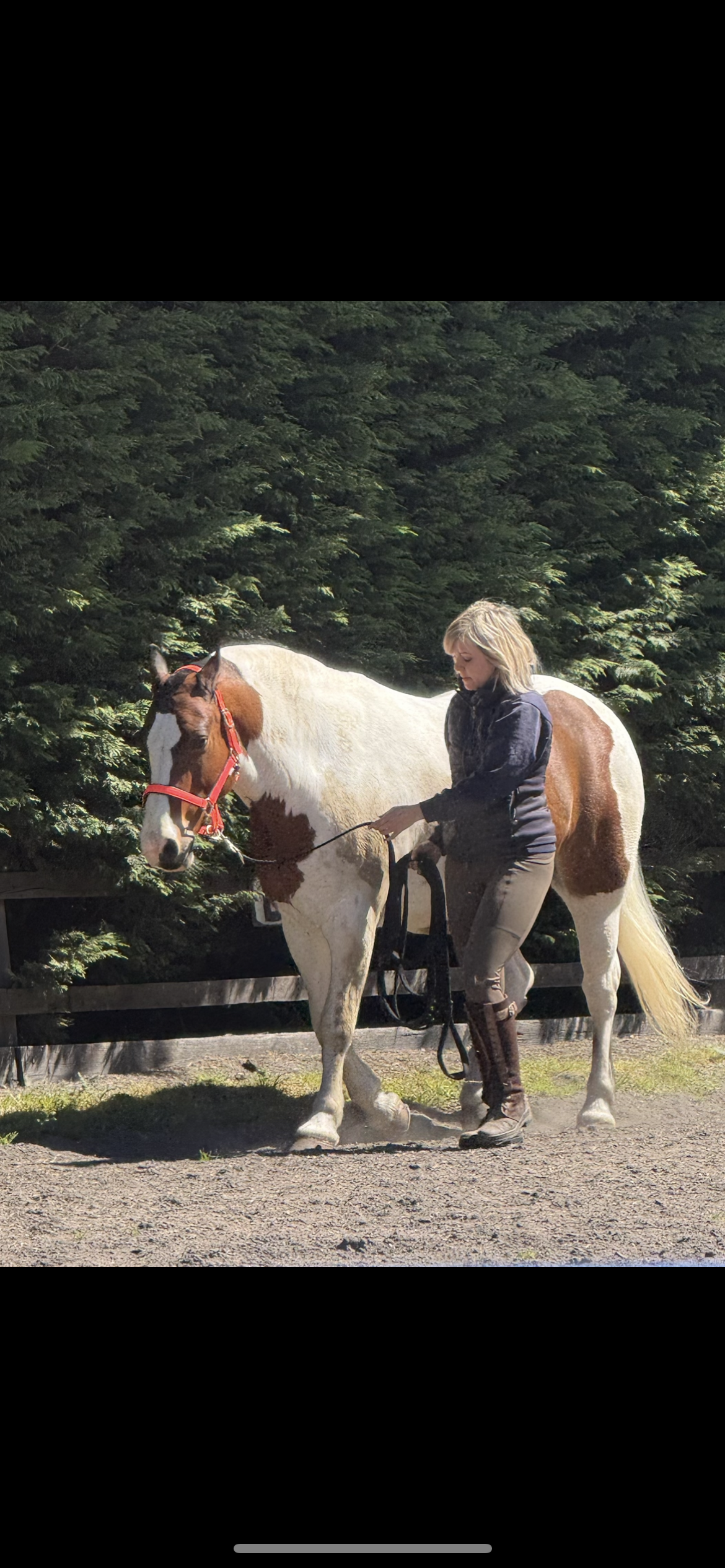
The bottom photograph was taken a week later,
We can see from this picture how much softer she is through her neck and shoulders, how she's starting to weight into her heels and lock her knee's, supporting her body, the angle of her spine is more neutral, her hind limbs are more perpendicular to the ground, overall she is more softer and more connected to the ground.
Also she had been fine being girthed up and also was so much calmer, when I arrived she was settled in her stable eating her hay-net, a different horse to the one I saw a week prior, Her owner commented on how much more relaxed she had been since her treatment with me. I have shared this clients horse as she is a great example of how what we see on the outside mirrors whats on the inside.
This mare had previously raced and had endured a 7 hour road trip to her new home, the transport lady said that she was very stressed during this journey, this is all part of the puzzle and tension I could see. Her body was very much still stuck in this tension and brace and once i was able to guide her through awareness exercises and manual release she was able to come down from the stressed state into more of a parasympathetic (rest and digest) and find her way back to homeostasis.
When there are restrictions within certain muscle groups this signals to the nervous system that the horse is not safe, it triggers an internal alarm system and the horse appears to remain in a sympathetic state no matter what we do to try to help our horse they don't have the capacity to regulate their nervous system and come back to a parasympathetic state.
Once I was able to release tension in key areas for this mare, she was able to feel safe within her body, allowing her nervous system to settle down. Through gentle, intentional movements we can start to create new neuromuscular connections and build a strong, balanced and happy horse.
Some techniques I use during my treatment sessions.

My work helps a horse to release habitual tension and restrictions through gentle intentional movement, working on allowing the horse to feel what it is like to move without brace, releasing old patterns.
Habitual patterns run deep in the autonomic nervous system to save energy, even when they are not serving the body in a positive way, the movement techniques that I use bring awareness through non habitual movement, this rely's on the conscious thinking part of the brain and starts to create new neural pathways through something called neuroplasticity.

Working to restore proprioception by creating awareness of the body, allowing the horse to settle into the pad, to help feel extension through their joints, creating awareness and restoring the push into the ground, this allows them to find stability and with that a sense of safety, allowing activation of the parasympathetic nervous system. This helps with emotional balance, strength and stability, creating awareness of the horses body reprogramming and creating new neural pathways in healthier more functional movement patterns.
I also use body wraps and somatic movements during treatments as and when needed to again create awareness and to help with specific muscle activations to re-programme neuromuscular connections building strength and stability.

I use Manual myofascial release and specific nerve release techniques as and where needed, working with the horse, listening and feeling for tension and brace under my hands and guiding the horse through a gentle release. When we are able to react to the slightest change within the tissue, the horse recognises and feels this and it creates a sense of safety within the horse, this is when you feel them really start to let you in.
We are able to see changes that last
Change starts with awareness

Bev came to see my lovely but very guarded rescue/ rehab mare this week, and was nothing short of incredible. My mare has multiple physical challenges and a ripple of compensation patterns and poor posture as a result, which we are trying to rehab. She worked carefully within my horse’s emotional thresholds, whilst gently encouraging her to accept more and more touch and adjustment. She made huge differences to muscle movement and relaxation within just one visit, and was incredibly generous with both her time and her knowledge. I feel I’m lucky to have found her, and am looking forward to working with her again. My new mare is a very good judge of intention and if she trusts Bev, so do I! Thank you
— Thea Dexter, horse owner
I've been meaning to write a review for ages but never quite finding the words to describe how Bevs work really helps horses.
Bev has worked with our horses for a while now and the improvements in their bodies and well being are a joy to see.
Having seen my big Irish horse, who has taken some unravelling with past trauma and dysfunctional body usage, this week, I decided to show a photo, that to many will mean nothing, but to me it's like we've won the lottery for him!
He's finally been able to find a leg at each comer and trust that he can balance himself. Photo a day after treatment. this horse never stands square. he always stands base narrow. He hung out there for ages, his walk was much more balanced afterwards and most importantly he felt so comfortable in himself.
Bev has a true talent and I highly recommend her frequently to my own clients. Highly intuitive and able to tailor sessions for different horses and personalities, which for me is crucial.
— Ruth Fisher, horse owner and bit and bridle fitter
I'm very cautious when I have someone come to work on my horses but I can say that Bev put me at ease straight away.
Bev was very kind and patient with my boys and she took her time gaining their confidence never pushing them past their threshold,really easy to chat to and explained everything she was doing,looking forward to our next visit and would recommend to friends.
— Vivienne Lubowicki], horse owner
Give your horse the time and understanding they deserve
Research shows that when a horse is stressed their Nervous system shifts into survival mode, being able to recognise this is key, a huge part of this is muscle tone and development. When the horse is operating predominantly from a sympathetic state, the body braces and resists and almost becomes stuck this way.
When the Nervous system is able to settle, movement becomes easier, more balanced and more consistent and the horse becomes more regulated, with this the horse starts to build strength and stability for a healthier more functional posture.
Get in touch
Based in Swanwick Derbyshire
Balanced Bodywork Equine Therapy
Swanwick, United Kingdom
Telephone: 07814419144
Email: info@balancedbodyworkequinetherapy.co.uk